O Jogo Estratégico da Inteligência Artificial - pt 1The Strategic Game of Artificial Intelligence - pt 1
Estamos vivenciando o nascimento e impacto nas nossas próprias vidas da Inteligência Artificial. E por ser uma tecnologia que literalmente interage diretamente conosco em nível individual e pessoal, percebemos o impacto de forma muito mais assertiva. Diante da experiência e um pouco de curiosidade sobre para onde a tecnologia está indo, não há como não nos impressionarmos. E já há nesse momento uma indústria vendendo vislumbres do futuro revolucionário e as benesses da tecnologia.
Apartada a discussão mais imediatista, creio que há, contudo, uma perspectiva ainda mais interessante se compreendermos melhor o tempo em que vivemos. Vou propor então uma discussão em duas partes: (i) compreender a Inteligência Artificial sob uma definição, a de Tecnologia de Propósito Geral1 (do original “General Purpose Technology”, ou simplesmente “GPT”), e ainda à luz desta definição, entender o impacto de GPTs ao longo da história; (ii) usar o caso da máquina a vapor, outra GPT, para nos direcionar a algumas perguntas.
General Purpose Technologies (“GPTs”)
Uma GPT2, tal como o termo foi cunhado, é uma tecnologia que se difunde por quase todos os setores da economia, fica mais barata ao longo do tempo e produz cadeias de inovações complementares que realimentam a própria tecnologia. Nesse conceito, temos como exemplo, em diferentes momentos da história, a descoberta do Ferro, a Máquina a Vapor, a Imprensa, a Eletricidade, o Computador, a Internet, dentre outras. Nesse contexto, creio que muito para além da Inteligência Artificial, estamos em uma era de avanço exponencial da humanidade que ganha tração significativa a partir do século XVIII.
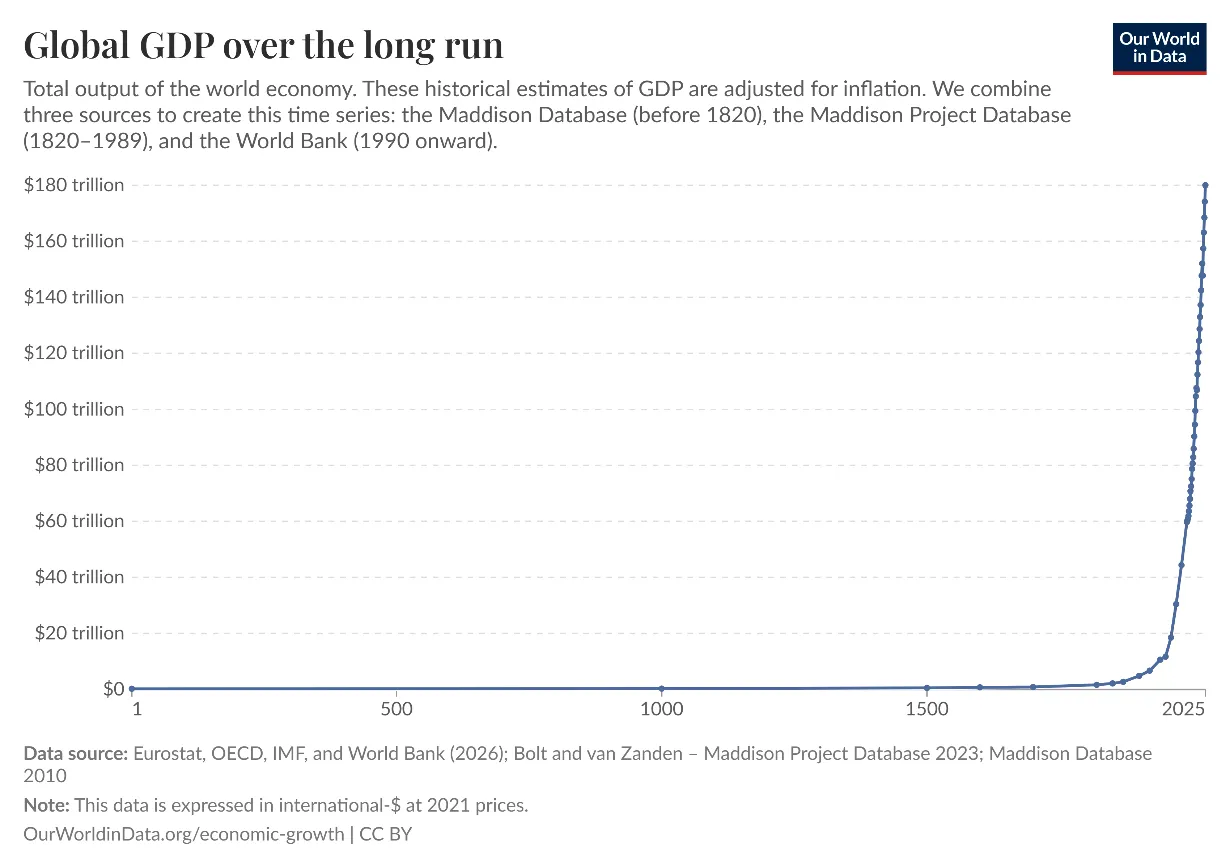
Para se ter ideia de como vivemos um período de aceleração e sua relação com as GPTs, vamos começar notando que, entre o século I e o século XVIII (1700 d.C.), o PIB mundial, medido em international-dollars3, saltou de 248 bilhões para 873 bilhões (3,52x). Já em 2025, este número, pela mesma metodologia, teria saltado para 180 trilhões (um salto de 206x em 300 anos).
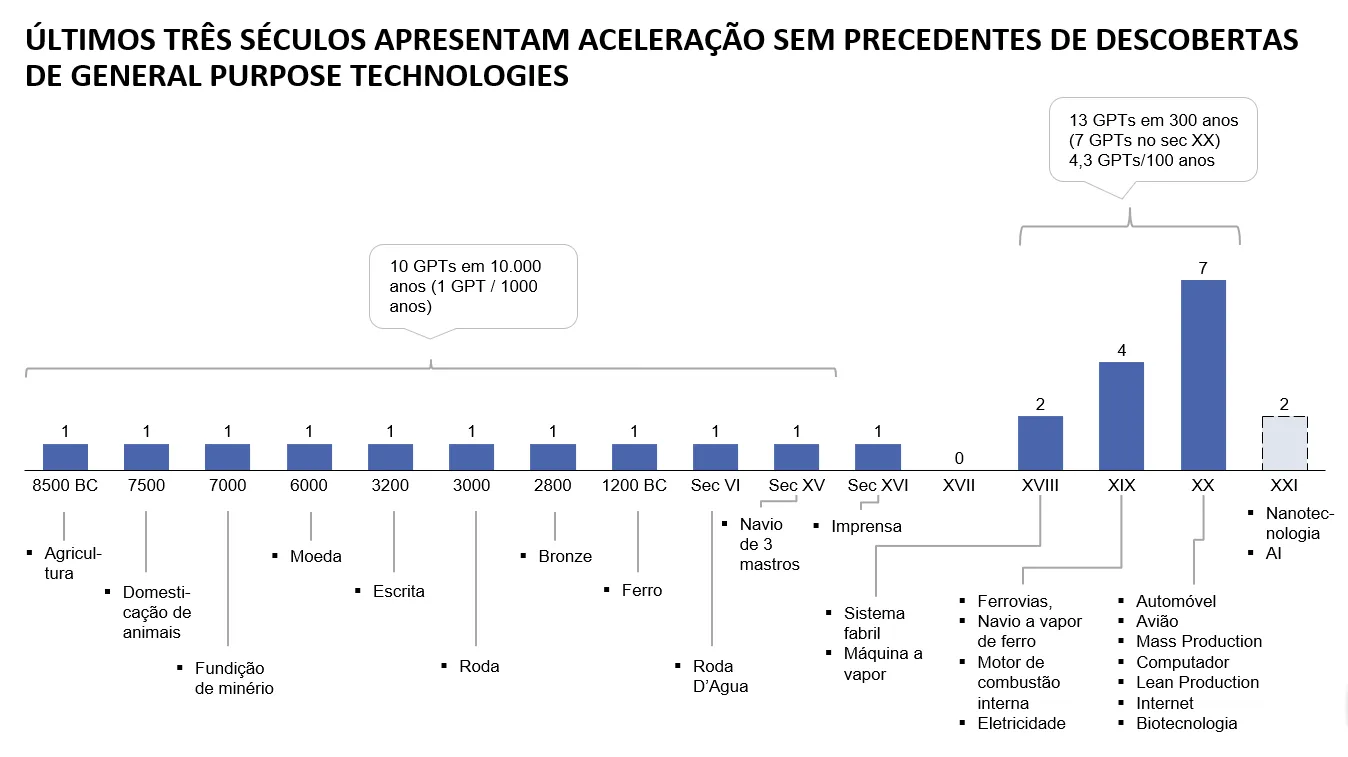
Por causalidade ou correlação, paralelamente, em seus primeiros dez mil anos de história, a humanidade produziu, dentro do conceito apresentado de GPTs, um total de apenas 10 GPTs (vide quadro abaixo). Em média, estamos falando de 1 GPT a cada 1.000 anos de história, com período entre descobertas variando de 200 a 2.800 anos.
Por outro lado, nos últimos trezentos anos, que coincidem com a multiplicação do PIB por 206x, a humanidade produziu 13 GPTs, em ritmo crescente e, ao que tudo indica, acelerando. O século XX produziu sozinho 7 GPTs: automóvel, avião, produção em massa, computador, produção enxuta, internet e biotecnologia. Tudo indica que em 2026 já temos 2 GPTs, a nanotecnologia e, em seus primeiros dias, a Inteligência Artificial.
A aceleração do último século
Seria incompleto tratar da aceleração na produção de GPTs sem mencionarmos ao menos um exemplo por trás de tais descobertas. A aceleração observada no último século tem relação direta com a conexão entre tecnologias desenvolvidas, em especial a evolução da engenharia em suas múltiplas disciplinas que deram lugar à evolução da eletrônica, a começar pelo eletromagnetismo e pela eletricidade.
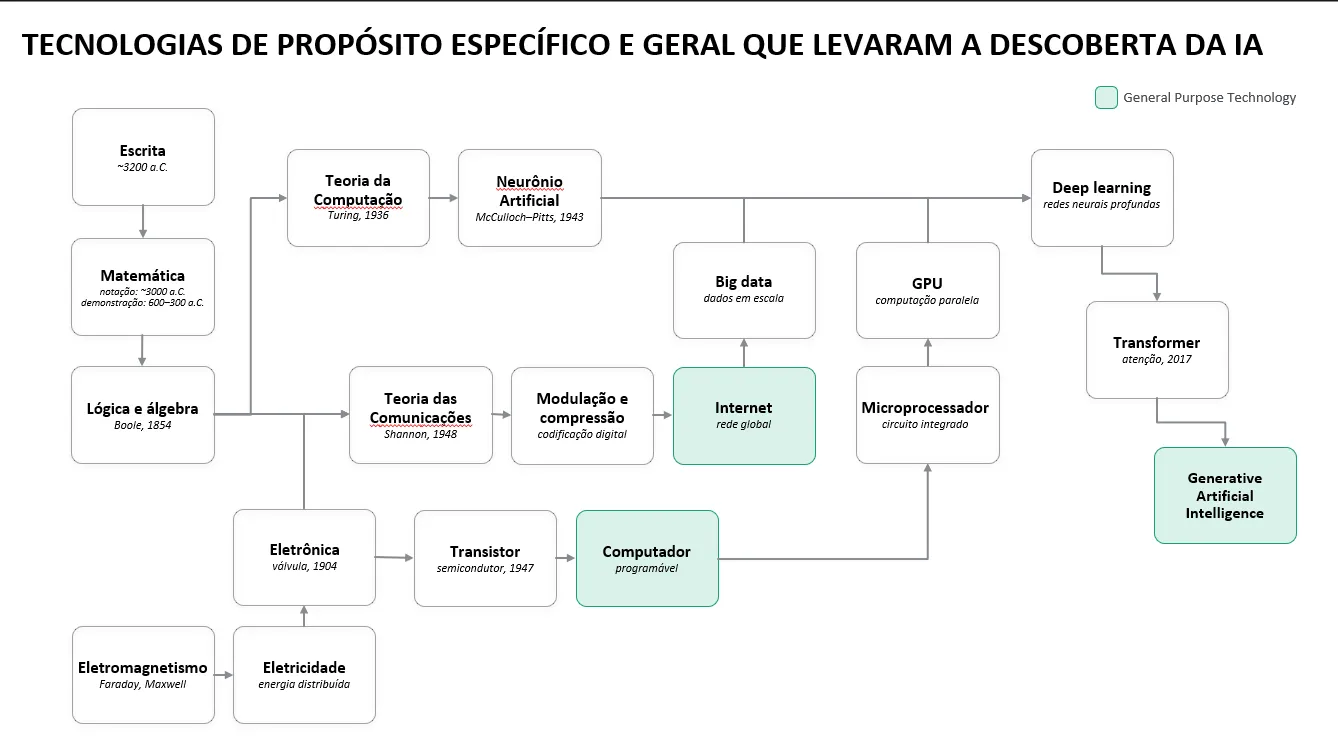
A evolução se deu com a descoberta do eletromagnetismo, prosseguiu pela evolução das comunicações, pela descoberta do processamento computacional, pela evolução da microeletrônica e microprocessadores, culminando na conectividade massiva, no acúmulo de conhecimento e na democratização do acesso ao mesmo via internet. Por fim, não menos importante, vieram a Lei de Moore e o avanço da litografia para a nanoeletrônica, que pavimentaram o caminho para a Inteligência Artificial.
Vê-se que a Inteligência Artificial hoje só é possível por conta da existência, evolução e sinergia criada a partir do emprego simultâneo de quase todas essas tecnologias acima mencionadas, quer sejam de propósito geral ou específico. Tal qual a própria Inteligência Artificial, uma GPT carrega inúmeras tecnologias em seu passado, tanto de propósito geral, quanto específico.
Impacto, Implantação e Prosperidade
Conhecimento, historicamente, era um ativo difuso, cujos mecanismos de compartilhamento evoluíram lentamente através da escrita, da imprensa, dos livros e, com maior aceleração através da internet e da digitalização. Já a inteligência, em qualquer de suas vertentes (intelectual, emocional, etc.), sempre foi um ativo escasso.
A Inteligência Artificial, enquanto GPT, altera drasticamente esse cenário. O conhecimento, por certo, já é passível de ampla difusão através dos múltiplos chats existentes. A inteligência em si já avança de forma extremamente acelerada, e a discussão atual é quão rápido os modelos se tornarão mais inteligentes do que os seres humanos (com alguns argumentando que os mesmos já são).
Toda esta tecnologia deve agora seguir o curso natural de ser implantada na sociedade, e naturalmente há ainda muitas perguntas a serem respondidas. Vamos ver o que podemos aprender da história, tanto em perguntas como potenciais respostas.
Case in Point: Motor a Vapor
Praticamente contemporânea da Revolução Industrial, a máquina a vapor é um exemplo de GPT que avançou gradativamente para um impacto transformacional na sociedade. Inicialmente, sua aplicação começou em mineração4, usando a pressão atmosférica com grande ineficiência para conversão em energia mecânica. Com sua evolução5 e sofisticação gradativas, ela então libertou fábricas da dependência de rios para força-motriz em suas máquinas. Por fim, ao mudar de baixa-pressão para alta-pressão, as máquinas a vapor viabilizaram ferrovias e navios a vapor. Esses avanços então, gradativamente, permitiram que a sociedade se reorganizasse para um nível de eficiência muito maior.
Mais que isso, as fábricas passaram a ser implantadas mais próximas a seus mercados consumidores. As ferrovias podiam então transportar em escala e com rapidez os bens produzidos em um determinado lugar até outros mercados. Para melhor gerenciar a logística, foram padronizados os fusos horários. Surgiu também a oportunidade de investir em escala para implantar ferrovias, que se tornaram enormes, e com elas um novo salto na forma de organização de empresas: foram criadas as Corporações. E, com as corporações e seus investidores, surgiu uma nova necessidade de controlar as finanças e prestar contas — e, com isso, os métodos de contabilidade e relatórios gerenciais. Em um intervalo de 100 anos, a sociedade deu um salto gigantesco em todos os aspectos.
Nesse contexto, vale ressaltar ainda uma curiosidade. Boa parte dos avanços foram literalmente bloqueados por Watt, o inventor da máquina a vapor em baixa-pressão. Preocupado com o risco de explosão ao trabalhar com alta-pressão, Watt foi extremamente resistente à migração para alta-pressão, e usou proativamente suas patentes para bloquear essa evolução, que só ocorreu após a expiração de suas patentes, em 18006.
Conselhos e CEOs: The Game is On
É claro que sempre há diferenças significativas entre eras, como também há paralelos significativos. Conforme a Inteligência Artificial evolui, nossa tendência é nos maravilharmos com a tecnologia e extrapolarmos seu impacto em nossos modelos mentais existentes. Tentamos assim reimaginar a tecnologia em sua maturidade, inferindo sua aplicação em diferentes campos de conhecimento e na própria sociedade.
O exemplo da máquina a vapor nos mostra muitos paralelos. Primeiro de tudo, logo após a tecnologia ser inventada, seu primeiro uso foi em escopos bem restritos: minas de carvão. Seria este o uso da IA via chat para consultas de conhecimento? Ou seria a primeira automação óbvia, em que agentes são usadas para executar pequenas tarefas operacionais? O conceito é: qual a aplicação mais óbvia disso que foi inventado? Claro, há muitas diferenças uma vez que a IA nasce muito mais ampla. Mas penso que este momento ainda é sobre estarmos bem no começo.
O maior desafio está no médio e na longa jornada, para muito além dos primeiros usos óbvios. É neste horizonte que reside substancial grau de incerteza. Foi nesse horizonte que foram criadas as ferrovias e o navio a vapor.
E ficam as questões mais provocativas. Quando a primeira máquina a vapor foi inventada, aqueles que estavam próximos à tecnologia não teriam imaginado sua “maturidade”? Não teriam imaginado como ela poderia evoluir para diferentes esferas da sociedade? Até que ponto conseguiram imaginar? Será que vislumbraram navios a vapor cruzando oceanos com alta previsibilidade e risco reduzido de se desviarem de rotas devido à imprevisibilidade dos ventos? Será que imaginaram a revolução que ocorreria através da conexão entre continentes, pessoas, mercados e produtos? O que será que imaginaram como riscos? Será que o dilema de Watt em adotar alta-pressão não fazia mesmo sentido? Sua resistência teria sido uma bênção, dando maior tempo para maior pesquisa e maturação da alta-pressão, ou teria sido um atraso na evolução da máquina a vapor para se tornar portátil?
Repensar como certa tecnologia, que nasce em outro escopo totalmente diferente, vai alcançar um determinado setor ou negócio, é um exercício extremamente elaborado. Ousaria dizer que aqueles que o fazem diligentemente, tem maiores chances de não serem surpreendidos.
E é nessa linha que a maior parte das lideranças - Conselhos e CEOs - serão desafiados. E mais do que isso, serão desafiados em uma era de extrema aceleração, em qua a própria tecnologia de IA se acelera para ampliar seu impacto (como já tem sido feito nos treinamentos de modelos mais recentes). A Destruição Criativa de Schumpeter chegando em uma velocidade provavelmente muito maior do que já foi testemunhado na história.
No próximo artigo vou endereçar dinâmicas de estratégia que aprofundam mais este debate.
Footnotes
-
Para definição de GPT, consultar Bresnahan e Trajtenberg, “General Purpose Technologies: ‘Engines of Growth’?” Journal of Econometrics ↩
-
Mapeamento de GPTs na história da humanidade realizado em Richard Lipsey, Kenneth Carlaw e Clifford Bekar, Economic Transformations: General Purpose Technologies and Long-Term Economic Growth, Oxford University Press, 2005 (ISBN 0-19-929089-X). ↩
-
Para o PIB ao longo dos séculos, metodologia e international-dollars, ver https://ourworldindata.org/grapher/global-gdp-over-the-long-run?time=1..2025#faqs ↩
-
Thomas Newcomen, máquina “atmosférica”. ↩
-
James Watt, patente registrada em 1776. ↩
-
Richard Trevithick, patente de alta-pressão em 1802. ↩
We are living through the birth of Artificial Intelligence and its impact on our own lives. And because it is a technology that literally interacts with us directly, at an individual and personal level, we perceive its impact far more acutely. Faced with the experience — and with a bit of curiosity about where the technology is heading — it is impossible not to be impressed. And there is already, at this very moment, an industry selling glimpses of the revolutionary future and the blessings the technology will bring.
Setting aside the more immediate discussion, I believe there is, nonetheless, an even more interesting perspective to be gained if we better understand the times in which we live. I will therefore propose a discussion in two parts: (i) understanding Artificial Intelligence under a particular definition, that of a General Purpose Technology1 (from the original “General Purpose Technology”, or simply “GPT”), and, still in light of this definition, understanding the impact of GPTs throughout history; (ii) using the case of the steam engine, another GPT, to steer us toward a few questions.
General Purpose Technologies (“GPTs”)
A GPT2, as the term was coined, is a technology that diffuses across nearly every sector of the economy, becomes cheaper over time, and produces chains of complementary innovations that feed back into the technology itself. Under this concept, we find as examples, at different moments in history, the discovery of Iron, the Steam Engine, the Printing Press, Electricity, the Computer, the Internet, among others. In this context, I believe that far beyond Artificial Intelligence, we are in an era of exponential human advancement that gains significant traction from the 18th century onward.
To get a sense of just how much we are living through a period of acceleration and its relationship to GPTs, let us begin by noting that, between the 1st century and the 18th century (1700 AD), world GDP, measured in international dollars3, jumped from 248 billion to 873 billion (3.52x). By 2025, this figure, under the same methodology, would have jumped to 180 trillion (a 206x leap in 300 years).
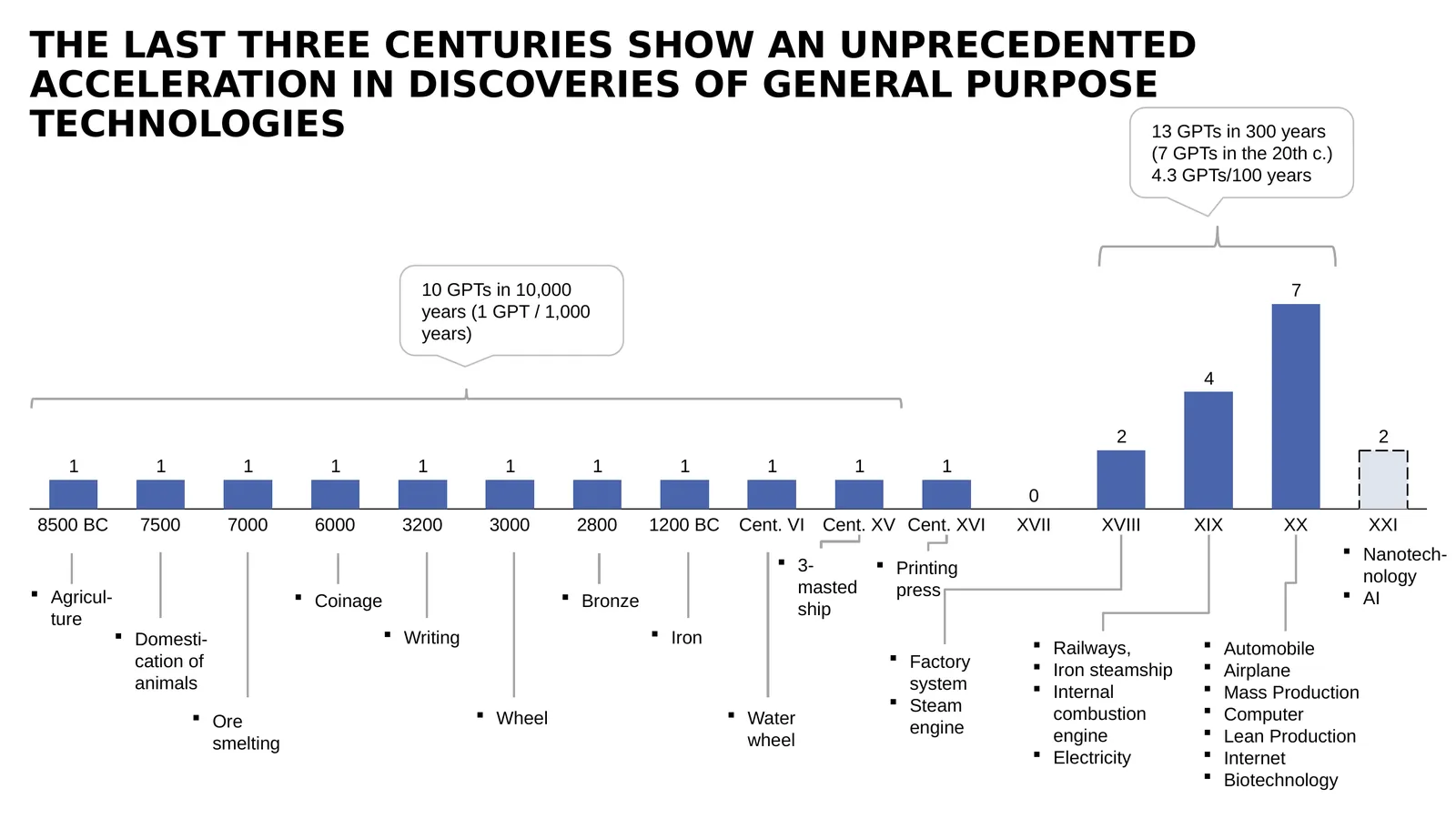
Whether by causation or correlation, in parallel, over its first ten thousand years of history, humanity produced — within the presented concept of GPTs — a total of only 10 GPTs (see the chart below). On average, we are talking about 1 GPT every 1,000 years of history, with the interval between discoveries ranging from 200 to 2,800 years.
By contrast, over the last three hundred years, which coincide with the 206x multiplication of GDP, humanity produced 13 GPTs, at a growing pace and, by all indications, still accelerating. The 20th century alone produced 7 GPTs: the automobile, the airplane, mass production, the computer, lean production, the internet, and biotechnology. Everything indicates that by 2026 we already have 2 more GPTs: nanotechnology and, in its very first days, Artificial Intelligence.
The acceleration of the last century
It would be incomplete to address the acceleration in the production of GPTs without mentioning at least one example behind such discoveries. The acceleration observed over the last century is directly related to the connection between the technologies developed, in particular the evolution of engineering across its multiple disciplines, which gave rise to the evolution of electronics, beginning with electromagnetism and electricity.
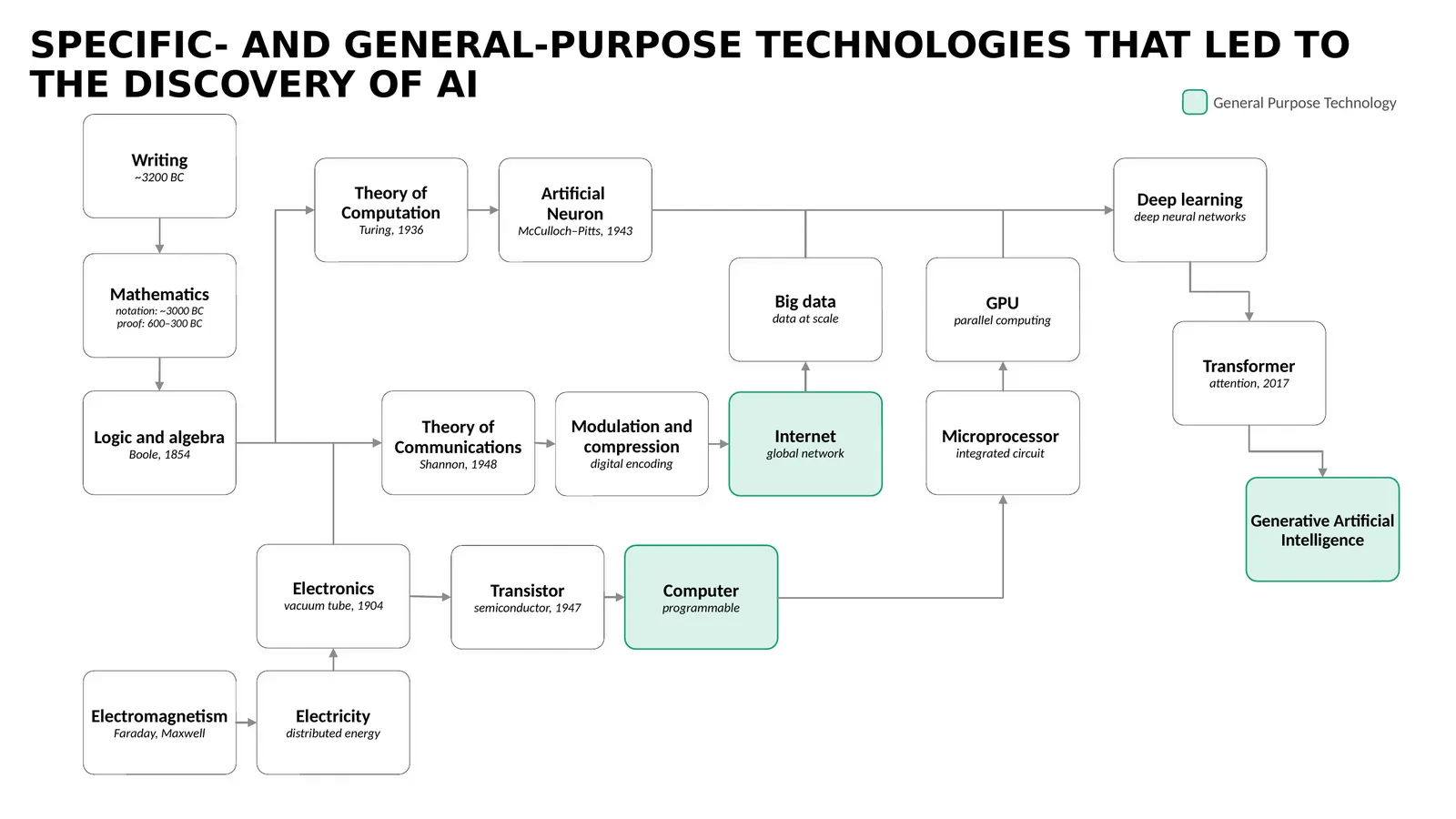
This evolution came with the discovery of electromagnetism, continued through the evolution of communications, through the discovery of computational processing, through the evolution of microelectronics and microprocessors, culminating in massive connectivity, the accumulation of knowledge, and the democratization of access to it via the internet. Finally, and no less important, came Moore’s Law and the advance of lithography toward nanoelectronics, which paved the way for Artificial Intelligence.
It becomes clear that Artificial Intelligence today is only possible because of the existence, evolution, and synergy created from the simultaneous employment of nearly all of the technologies mentioned above, whether general or special purpose. Like Artificial Intelligence itself, a GPT carries countless technologies in its past, both general and special purpose.
Impact, Deployment, and Prosperity
Knowledge, historically, was a diffuse asset, whose mechanisms of sharing evolved slowly through writing, the printing press, and books, and, with greater acceleration, through the internet and digitalization. Intelligence, on the other hand, in any of its forms (intellectual, emotional, and so on), has always been a scarce asset.
Artificial Intelligence, as a GPT, drastically alters this scenario. Knowledge, to be sure, is already subject to wide diffusion through the many chatbots that exist. Intelligence itself is already advancing at an extremely accelerated pace, and the current debate is how quickly the models will become more intelligent than human beings (with some arguing that they already are).
All of this technology must now follow the natural course of being deployed across society, and naturally there are still many questions to be answered. Let us see what we can learn from history, both in terms of questions and of potential answers.
Case in Point: The Steam Engine
Almost contemporaneous with the Industrial Revolution, the steam engine is an example of a GPT that advanced gradually toward a transformational impact on society. Initially, its application began in mining4, using atmospheric pressure with great inefficiency to convert into mechanical energy. With its gradual evolution5 and sophistication, it then freed factories from their dependence on rivers for the motive power of their machines. Finally, by shifting from low pressure to high pressure, steam engines made railways and steamships viable. These advances then gradually allowed society to reorganize itself toward a far greater level of efficiency.
More than that, factories came to be located closer to their consumer markets. Railways could then transport, at scale and with speed, the goods produced in one place to other markets. To better manage logistics, time zones were standardized. There also arose the opportunity to invest at scale to build railways, which became enormous, and with them a new leap in the way companies were organized: the Corporation was created. And, with corporations and their investors, a new need arose to control finances and render accounts — and, with it, the methods of accounting and management reporting. Within a span of 100 years, society took a giant leap in every respect.
In this context, it is worth highlighting one more curiosity. A good part of these advances were literally blocked by Watt, the inventor of the low-pressure steam engine. Concerned about the risk of explosion when working with high pressure, Watt was extremely resistant to the migration to high pressure, and proactively used his patents to block that evolution, which only occurred after his patents expired, in 18006.
Boards and CEOs: The Game is On
Of course, there are always significant differences between eras, just as there are significant parallels. As Artificial Intelligence evolves, our tendency is to marvel at the technology and to extrapolate its impact onto our existing mental models. We thus try to reimagine the technology in its maturity, inferring its application across different fields of knowledge and across society itself.
The example of the steam engine shows us many parallels. First of all, right after the technology was invented, its first use was in very narrow scopes: coal mines. Would this be the use of AI via chat for knowledge queries? Or would it be the first obvious automation, in which agents are used to carry out small operational tasks? The concept is: what is the most obvious application of this thing that has been invented? Of course, there are many differences, since AI is born far broader. But I think this moment is still about our being at the very beginning.
The greatest challenge lies in the medium and the long journey, far beyond the first obvious uses. It is on this horizon that a substantial degree of uncertainty resides. It was on this horizon that railways and the steamship were created.
And the most provocative questions remain. When the first steam engine was invented, would those who were close to the technology have imagined its “maturity”? Would they have imagined how it could evolve into different spheres of society? To what extent were they able to imagine it? Did they envision steamships crossing oceans with high predictability and a reduced risk of drifting off course due to the unpredictability of the winds? Did they imagine the revolution that would come about through the connection between continents, people, markets, and products? What might they have imagined as the risks? Was Watt’s dilemma in adopting high pressure perhaps not so unreasonable after all? Was his resistance a blessing, granting more time for greater research and maturation of high pressure, or was it a delay in the evolution of the steam engine toward becoming portable?
Rethinking how a given technology, one born in a completely different scope, will reach a particular sector or business is an extremely elaborate exercise. I would venture to say that those who do it diligently stand a better chance of not being caught by surprise.
And it is along these lines that most leaders — Boards and CEOs — will be challenged. And more than that, they will be challenged in an era of extreme acceleration, in which AI technology itself accelerates to broaden its own impact (as has already been done in the training of the most recent models). Schumpeter’s Creative Destruction arriving at a speed likely far greater than has ever been witnessed in history.
In the next article, I will address strategy dynamics that delve more deeply into this debate.
Footnotes
-
For the definition of GPT, see Bresnahan and Trajtenberg, “General Purpose Technologies: ‘Engines of Growth’?” Journal of Econometrics ↩
-
Mapping of GPTs throughout human history drawn from Richard Lipsey, Kenneth Carlaw and Clifford Bekar, Economic Transformations: General Purpose Technologies and Long-Term Economic Growth, Oxford University Press, 2005 (ISBN 0-19-929089-X). ↩
-
For GDP across the centuries, the methodology and international dollars, see https://ourworldindata.org/grapher/global-gdp-over-the-long-run?time=1..2025#faqs ↩
-
Thomas Newcomen, the “atmospheric” engine. ↩
-
James Watt, patent registered in 1776. ↩
-
Richard Trevithick, high-pressure patent in 1802. ↩